
Vesterbro
Istedgade, Kødbyen and Enghaveparken behind Central Station
Behind Central Station lie Istedgade, the former slaughterhouses of Kødbyen with restaurants and bars, Sønder Boulevard and Enghaveparken.
Contents
What to see in Vesterbro comes down to a loop of three parts: Istedgade, the working-class street with its war-time history, the park and concert hall at Enghave Plads, and the Meatpacking District (Kødbyen), a former slaughterhouse complex that is now full of restaurants and bars. The name Vesterbro first belonged to the paved country road that led from the west to the city gate Vesterport, where City Hall Square lies today. Few country roads were paved at the time, and the dense traffic into the capital made it necessary here. Later in the 19th century the main street of the district was named Vesterbrogade. The walk below does not follow it but its parallel street, Istedgade, and ends in the old slaughterhouses.
Arriving at Central Station or Enghave Plads
The usual starting point is Copenhagen Central Station, designed by Heinrich Wenck and opened in 1911. The metro does not stop inside the station building but at its own station on Stampesgade, which a tunnel connects with the S-train platforms. Opposite the station, on Bernstorffsgade, is an entrance to Tivoli Gardens.
Istedgade begins at the station, and you can walk to Kødbyen from here as well, by way of Halmtorvet. To start at the other end, take the M3 to Enghave Plads and walk the loop in the opposite direction. For Værnedamsvej, the nearest metro station is Frederiksberg Allé.
A loop through Vesterbro
The loop follows Istedgade to Enghave Plads, turns into Enghavevej and returns along Sønder Boulevard and Halmtorvet to Kødbyen beside the station. Kødbyen comes last because its bars and restaurants stay open late. With little time, shorten the walk by taking the M3 back from Enghave Plads.
Istedgade and Stjerne Radio
Istedgade has carried its name since 1859, after the Battle of Isted in 1850. On the first stretch, around Mariakirken, there is a visible drug scene despite police operations; the church and the charities Kirkens Korshær and Mændenes Hjem look after people in need there. After pornography was legalised in 1969, almost every second shop on the street sold magazines and sex toys, and a few sex shops remain today.
The street has its roots in the working class. Before the urban renewal of the 1990s it was shaped by speculative buildings with small, badly built flats, and poverty was widespread. Today many of the flats along the street have been expensively renovated.
The resistance group Holger Danske was founded in the back room of the shop Stjerne Radio at Istedgade 31, which is now a museum. During the general strike of summer 1944 there were violent clashes in Vesterbro between residents and the German military. Leaflets were thrown from the top flats on Istedgade with the line "You can have Rome and Paris, but Stalingrad and Istedgade never surrender", and from this comes the slogan "Istedgade overgiver sig aldrig".
Enghave Plads, VEGA and Enghaveparken
Where Istedgade meets Enghavevej lies Enghave Plads, named in 1897, with the metro station and Kristkirken. VEGA also stands on the square. Vilhelm Lauritzen, who also built the Radiohuset, designed it as Folkets Hus for the labour movement. It opened in 1956 and remained the movement's meeting place until the early 1990s. Instead of a planned supermarket, a concert hall moved in during September 1996, and it is now one of the largest venues in Denmark.
Enghaveparken is on the same square. Until 1927 the allotment colony Haveforeningen Enghaven stood here, with about 160 plots of 120 m² each. The city architect Poul Holsøe then laid out a strictly neoclassical park with lawns, gardens, playgrounds and ball courts together with the newly qualified Arne Jacobsen, and it was opened in April 1929. At the stage in the west of the park stands the music pavilion Muslingeskallen, built in 1931, with a relief of Apollo and the nine Muses by Aage Nielsen-Edwin. From 2017 to 2019 the city rebuilt the park as part of its protection against cloudbursts.
From 28 November 2026 to 28 February 2027 there is a free ice rink in the park, and you can hire skates on site. Despite its cooling system the rink can close in mild and rainy weather; it usually reopens only when night temperatures are no higher than 1 to 2 degrees.
Sønder Boulevard and Halmtorvet
Enghavevej leads to Sønder Boulevard, which runs for about 1.3 km from Vesterfælledvej to Kødbyen. From 1847 to 1864 the innermost section of the Vestbanen, the first railway in Denmark, ran along its line. Between the two carriageways there is now a playground and a ball cage.
At the White Meatpacking District the boulevard turns into Halmtorvet. Until the end of 1887 the city's hay and straw market stood at Vesterport. On 1 January 1888 it moved, with its name, to the square in front of the Brown Meatpacking District. On Wednesdays and Saturdays, several hundred carts at a time arrived here with hay and straw for the city's cow and horse stables.
The Brown, Grey and White Meatpacking District
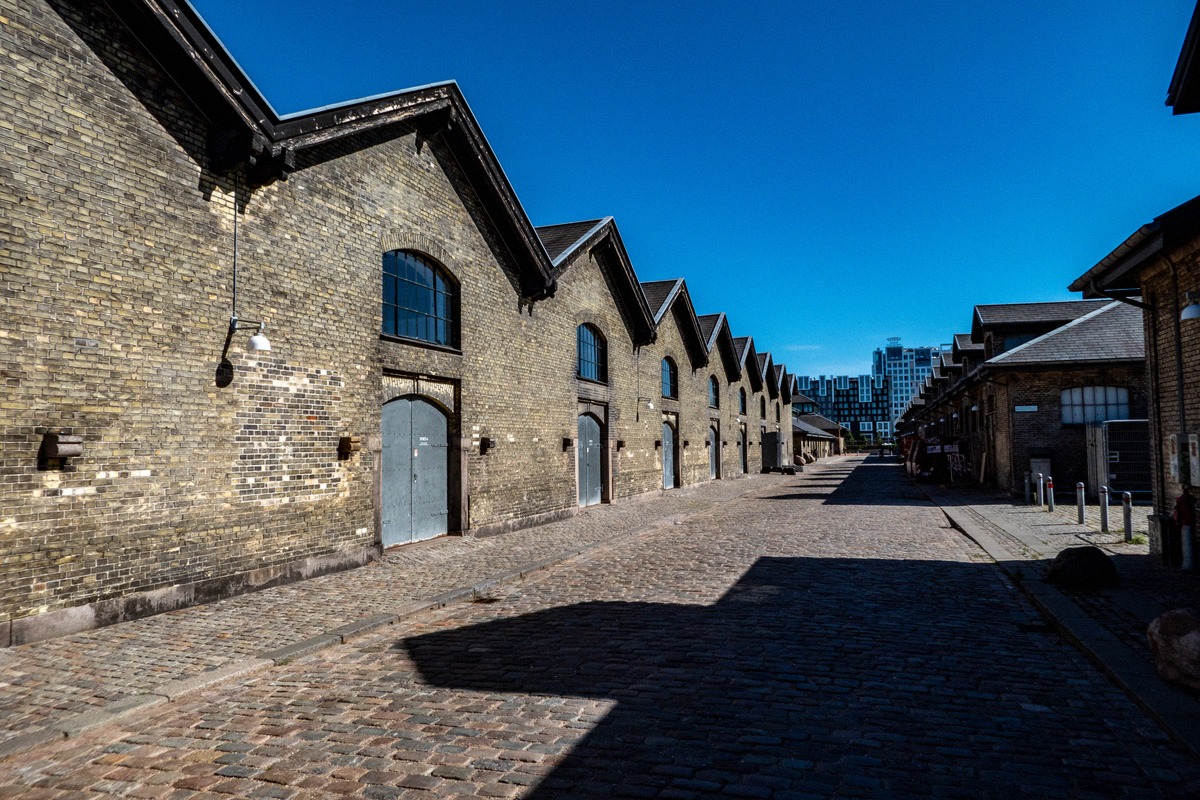
Kødbyen covers about 400 by 600 m between the tracks of Central Station, Ingerslevsgade, Halmtorvet and Skelbækgade. Its parts are named after the colour of the buildings: the oldest are of yellow brick that later changed colour, and the more recent ones are painted white.
The city built the Brown Meatpacking District in 1878 and 1879 to plans by Hans J. Holm, after the unhygienic slaughterhouse on Trommesalen had been closed. In 1901 the Øksnehallen by Ludvig Fenger and the Grey Meatpacking District were added. Cattle arrived on a freight track of the railway, were sold alive in the Øksnehallen, which had room for 1,600 animals, and were slaughtered in the Grey Meatpacking District on Slagtehusgade. The Øksnehallen now shows exhibitions and also houses the Københavns Musikskole; the other buildings of the Brown Meatpacking District hold training institutions and cafés, among others.
The meat was chilled in the White Meatpacking District, which Poul Holsøe, the same city architect as at Enghaveparken, built in reinforced concrete from 1931 to 1934. It is regarded as the main work of Danish functionalism and has about 46,000 m² of floor space. The centre of the complex is the Flæskehal with its saw-tooth roofs, and on its gable is the relief "Tyren" (The Bull) by Einar Utzon-Frank. Butchers and wholesalers still work here, alongside restaurants, galleries and creative firms that have moved into the halls.
Beer, oysters and communal dinners
For food and drink, two places on Flæsketorvet suit the end of the walk. WarPigs, founded by Mikkeller, is in a former slaughterhouse, serves 23 of its own beers on tap and cooks Texas-style barbecue. Kødbyens Fiskebar, also on Flæsketorvet, cooks fish and serves oysters all day.
On Sønder Boulevard you pass Absalons Kirke, consecrated in 1934 and sold later. It is now Folkehuset Absalon, a community house with a high hall, long tables and table-tennis tables. It serves breakfast in the morning and a shared dinner at the long tables in the evening.
Værnedamsvej and Carlsberg Byen next door
Værnedamsvej is about 190 m long and runs on the border with Frederiksberg from Gammel Kongevej to the junction of Vesterbrogade and Frederiksberg Allé. It is named after Werner Damm, who ran an inn here in the 1730s. The butchers of the past are gone, and the small shops and cafés now give the street a Parisian touch.
Carlsberg Byen, on the former site of the Carlsberg brewery, already belongs to the district of Valby (see neighbourhoods). The gates Elefantporten and Dobbeltporten have been preserved there. The first part of the quarter was finished in 2017, next to the S-train station Carlsberg, which was new at the time.